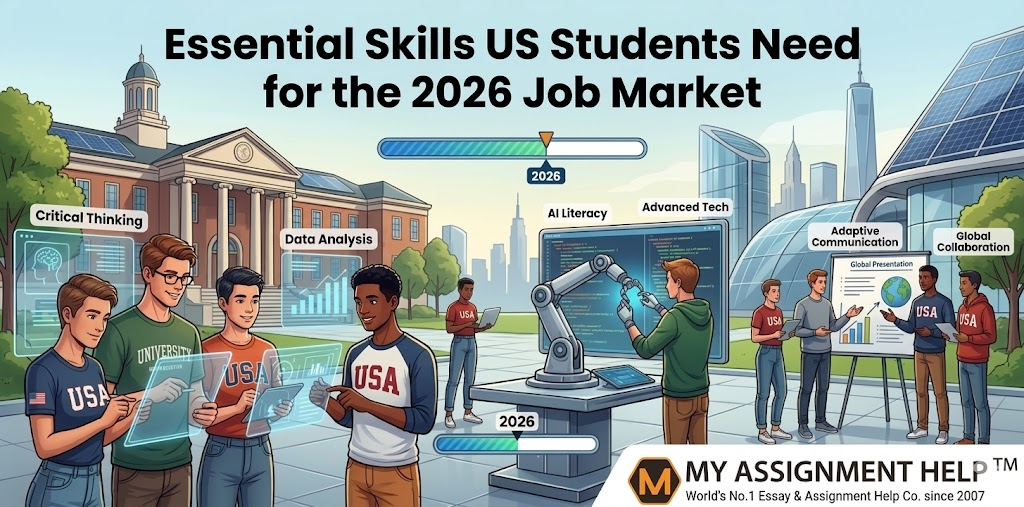
The American higher education landscape is undergoing a seismic shift. As we navigate through 2026, the traditional degree—while still a foundational asset—is no longer a guaranteed golden ticket to a career. The integration of generative AI into the workplace, the rise of the “skills-based” hiring model, and an increasingly volatile global economy have redefined what it means to be “job-ready.”
For students at institutions ranging from the Ivy League to state colleges, the challenge is clear: academic excellence must be paired with high-level cognitive and interpersonal competencies. The 2026 job market does not just reward what you know; it rewards how you apply that knowledge in automated environments.
The modern academic workload has become increasingly complex as students struggle to balance these emerging professional requirements with rigorous coursework. To manage this transition, many students seek essay help online to streamline their writing assignments, allowing them to dedicate more time to hands-on skill acquisition and networking.
The Skill-to-Salary Bridge: Navigating the 2026 Landscape
In 2026, the “Skill-to-Salary” bridge is the most critical concept for any graduate. This involves identifying the specific “multiplier skills” that increase the value of a base degree.
1. AI Fluency and Prompt Engineering
By 2026, basic computer literacy has been replaced by AI fluency. Employers are looking for “Centaur” workers—those who can collaborate with AI to produce results faster and more accurately than a human or a machine could do alone.
- The Nuance: It is no longer about asking a chatbot to write an email. It is about understanding the architecture of Large Language Models (LLMs) to perform data synthesis, code debugging, and automated project management.
2. Data Storytelling and Visualization
Data is the new oil, but storytelling is the refinery. The ability to take a complex dataset and translate it into a narrative that stakeholders can understand is a high-income skill.
- Key Tooling: Proficiency in Tableau, PowerBI, and Python-based visualization libraries is now a standard requirement in marketing, finance, and even HR roles.
3. Emotional Intelligence (EQ) in a Virtual World
As technical tasks are increasingly automated, the “human” element becomes more valuable. Hybrid work models dominate 2026, making “Digital EQ”—the ability to lead, empathize, and collaborate across screen-mediated environments—essential.
The “Academic Survival Stack” for 2026
To thrive, students must build an “Academic Survival Stack.” This is a combination of traditional literacy and modern technical execution. However, the pressure of maintaining a high GPA while building this stack can be overwhelming. Many students find that they need to write my essay for money through professional services to ensure their technical reports and capstone projects meet the high E-E-A-T standards required by modern universities.
Strategic Time Management
The most successful students in 2026 are those who treat their education like a startup. They outsource repetitive tasks and focus their “Deep Work” hours on high-value learning. This involves:
- Micro-Credentialing: Supplementing a degree with certifications from Coursera, EdX, or industry-specific providers (e.g., AWS, HubSpot).
- Critical Thinking under Pressure: Moving beyond rote memorization to case-study-based problem-solving.
Data-Driven Insights: The Shift in US Hiring
According to recent labor statistics and industry reports, 75% of Fortune 500 companies have implemented “skills-first” hiring, often removing degree requirements for mid-level roles.
| Skill Category | Growth Projection (2024-2026) | Primary Industry Impact |
| AI Interaction | +45% | Tech, Marketing, Finance |
| Sustainability Literacy | +30% | Manufacturing, Logistics |
| Ethical Reasoning | +25% | Law, Healthcare, AI Dev |
| Cross-Cultural Competency | +20% | Global Sales, HR |
Sources: Bureau of Labor Statistics (BLS) Occupational Outlook, LinkedIn Emerging Jobs Report 2026.
Key Takeaways
- AI is a Colleague, Not a Tool: Master prompt engineering and AI-human collaboration.
- Soft Skills are Hard Assets: Leadership, adaptability, and EQ are the only skills AI cannot currently replicate.
- The Hybrid Advantage: Gain experience in managing projects across time zones and digital platforms.
- E-E-A-T in Academics: Ensure your written work demonstrates Experience, Expertise, Authoritativeness, and Trustworthiness to stand out to both professors and future employers.
FAQ Section
Q: Is a college degree still worth it in 2026?
A: Yes, but the degree serves as the foundation. The “extras”—internships, AI certifications, and a portfolio of real-world projects—are what actually secure the job offer.
Q: What is the most in-demand soft skill?
A: Adaptability. The ability to “unlearn” old processes and “re-learn” new technologies as they emerge every 6-12 months is the most cited requirement by US recruiters this year.
Q: How can I improve my data storytelling skills?
A: Start by learning to analyze small datasets in Excel or Google Sheets, then move into visualization tools. The goal is to answer the “So what?” for any piece of data you present.
Q: Should I mention my use of AI in my portfolio?
A: Absolutely. Employers in 2026 want to see how you use AI to enhance your productivity, provided you maintain ethical standards and “human-in-the-loop” verification.
Author Bio: Dr. Aris Thorne
Dr. Aris Thorne is a Senior Content Strategist at MyAssignmentHelp, specializing in educational technology and workforce transition. With over 12 years of experience in academic consulting and a Ph.D. in Organizational Leadership, Dr. Thorne focuses on helping students bridge the gap between classroom theory and the 2026 digital economy. His work emphasizes the importance of E-E-A-T in academic writing and professional branding.
References:
- U.S. Department of Education (2025). The Future of Work and Higher Education Report.
- World Economic Forum (2025). Future of Jobs Report: Focus on North America.
- Society for Human Resource Management (SHRM). 2026 Talent Trends.